
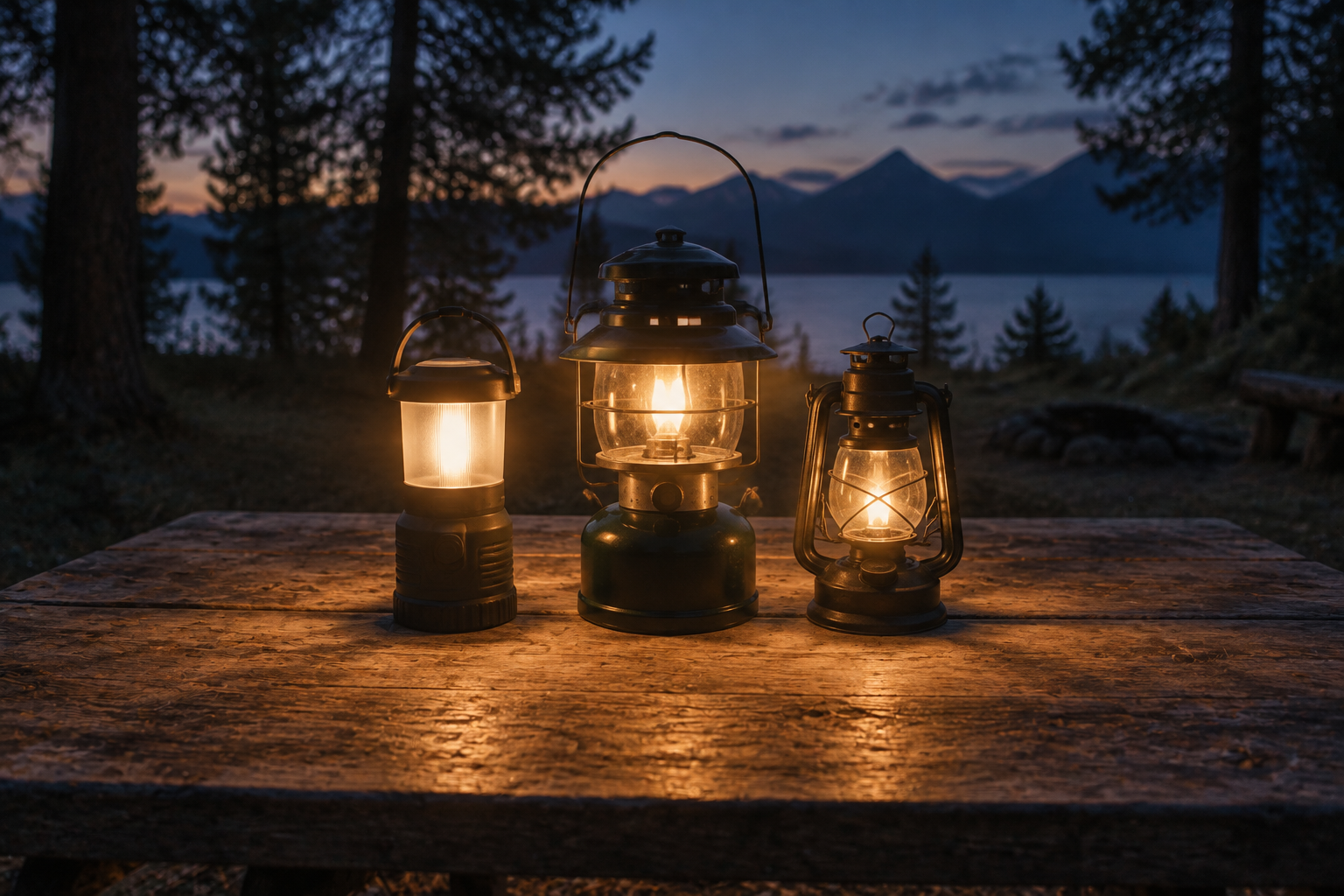
Best Camping Lanterns 2026: 5 Tested Picks
The best camping lantern for most people is the Glocusent C12. It gives a 1,500-lumen burst, three light colors, up to 200 hours on low and a USB-C port that charges your phone. The trade-off is weight: at 10.5 oz (299 g) it is a car-camping lantern, not a backpacking one, and it is only splash-resistant.
We picked the best camping lanterns for tents, campsite tables and power cuts, and we used all five in this guide hands-on. Our notes cover runtime, charging, hanging and what went wrong; lumen figures come from manufacturer specs, not a light meter. How We Test explains the method, and the camping lighting guides cover headlamps, flashlights and string lights.
| Product | Max brightness | Runtime on low | Weight (with batteries) | Water resistance | Match | |
|---|---|---|---|---|---|---|
| Glocusent C12 Rechargeable Camping Lantern Tested | 1,500 lm | 200 h | 10.5 oz | IPX5 | 78 | Check price |
| Etekcity Collapsible LED Camping Lantern (4-Pack) Tested | 154 lm | 50 h | 9.1 oz | — | 57 | Check price |
| FLY2SKY Clip-Hook LED Tent Lights (4-Pack) Tested | 150 lm | 45 h | 2.7 oz | IPX8 | 55 | Check price |
| XTAUTO Collapsible Solar/USB LED Lantern (4-Pack) Tested | — | 25 h | — | — | 18 | Check price |
| Odoland LED Camping Lantern with Ceiling Fan Tested | — | 20 h | 16 oz | IPX0 | 18 | Check price |
Glocusent C12 Rechargeable Camping Lantern: Best for most campers
Glocusent C12 Rechargeable Camping Lantern
The best-rounded rechargeable lantern here: warm light, 200 h low and phone charging.
- 1,500 lumens
- Up to 200 h on low, longer-lasting than 4 of 5 lights we compared
- IPX5
- Tested hands-on by Ventureora
- Trade-off: Heavier than most (10.5 oz)
The Glocusent C12 is the best all-round camping lantern here, but at 10.5 oz (299 g) it is heavier than every other pick except the Odoland fan lantern.
What we found: We used the Glocusent C12 as our main camp lantern. The three color modes, 3000K warm, 4500K neutral and 6000K cool, were each useful: warm for sitting around, cool for cooking and packing. On max steady brightness the battery lasted about 12 hours. On low it ran up to 200 hours. The 1,500-lumen burst mode only lasts 4 minutes, so treat it as a search light, not a working setting. A full recharge took 3.5 hours over USB-C.
How the Glocusent C12 scores
| Criterion | Glocusent C12 |
|---|---|
| Brightness | 10.0 (1,500 lumens) |
| Runtime | 10.0 (up to 200 h on low) |
| Weight | 4.0 (10.5 oz) |
| Water resistance | 5.5 (IPX5) |
| Affordability | 5.5 ($ price band) |
The Glocusent C12 has a 5,000 mAh battery, and the same USB-C port can top up a phone. That turns one lantern into a small power bank for a weekend. Glocusent’s product page rates the C12 IP44, while our notes and some listings say IP45. We use the lower figure: IP44 means it shrugs off rain and splashes but should not be dropped in a stream.
Key numbers: 1,500 lm burst · up to 200 h on low · 12 h on max steady · 5,000 mAh · 10.5 oz (299 g) · covers about 200 sq ft (18.6 m²) per Glocusent · 24-month warranty.
Who should skip the Glocusent C12: backpackers counting ounces. The FLY2SKY clip-hook lights weigh 2.7 oz (77 g) each and do the in-tent job for a quarter of the weight.
Etekcity Collapsible LED Camping Lantern (4-Pack): Best for power cuts and family tables
Etekcity Collapsible LED Camping Lantern (4-Pack)
The classic pop-up lantern four-pack for blackouts and campsite tables.
- 154 lumens
- Up to 50 h on low, longer-lasting than 3 of 5 lights we compared
- Strong buyer ratings
- Tested hands-on by Ventureora
- Trade-off: Pricier than most
The Etekcity four-pack is the easiest way to put a lantern in every room or tent, but each Etekcity lantern gives only about 154 lumens and eats AA batteries on high.
What we found: We used the Etekcity lanterns as pop-up lanterns. Batteries come in the box, so they work straight away. Each Etekcity lantern collapses to phone size and pulls up to switch on, and the pull height sets the brightness. On high, three AA cells lasted about 2.5 hours. On low, the same set lasted about 50 hours. Water resistance is not rated with an IP number, so we treated the Etekcity as a dry-weather light.
How the Etekcity CL10 scores
| Criterion | Etekcity CL10 |
|---|---|
| Brightness | 5.5 (154 lumens) |
| Runtime | 7.8 (up to 50 h on low) |
| Weight | 7.0 (9.1 oz) |
| Affordability | 3.3 ($ price band) |
Etekcity’s own page does not publish a lumen figure; the 154 lm in our table comes from our product data, so read it as approximate. The real cost of the Etekcity is batteries. At 2.5 hours per set on high, three nights of four hours each would use about five sets, or roughly 15 AA cells, per lantern. On low that drops to one set.
Key numbers: about 154 lm · up to 50 h on low (3 × AA) · 9.1 oz (258 g) · 4.9 × 3.5 in (12.4 × 8.9 cm) collapsed, 7.3 in (18.5 cm) tall open · 2-year warranty per Etekcity.
Who should skip the Etekcity four-pack: anyone who runs a lantern on high every night. The rechargeable Glocusent C12 runs 12 hours on max steady from one USB-C charge, with no batteries to buy.
FLY2SKY Clip-Hook LED Tent Lights (4-Pack): Best for tent ceilings and kids
FLY2SKY Clip-Hook LED Tent Lights (4-Pack)
Carabiner-clip mini lanterns for tent ceilings and kids.
- Up to 45 h on low
- 2.7 oz, lighter than 3 of 4 lights we compared
- IPX8
- Tested hands-on by Ventureora
- Trade-off: Dimmer than most (150 lumens)
The FLY2SKY clip-hook lights are the lightest lanterns here at 2.7 oz (77 g) each, but at about 150 lumens they light a tent, not a campsite.
What we found: We hung the FLY2SKY lights inside a tent. The carabiner hook clipped onto loops, pole sleeves and backpack straps without fuss. On AAA cells, each FLY2SKY light ran about 15 hours on high and about 45 hours on low. The four colors make it easy to hand one to each person, which helps with kids. The build is basic plastic, and batteries are not included.
How the FLY2SKY 4P-02 scores
| Criterion | FLY2SKY 4P-02 |
|---|---|
| Brightness | 1.0 (150 lumens) |
| Runtime | 5.5 (up to 45 h on low) |
| Weight | 10.0 (2.7 oz) |
| Water resistance | 10.0 (IPX8) |
| Affordability | 10.0 ($ price band) |
FLY2SKY advertises IPX8, which would mean continuous submersion, yet the FLY2SKY spec in our data also describes the lights only as “water resistant.” Those two claims do not match. We treated the FLY2SKY as splash-resistant and would not trust it in standing water. Our comparison table shows the claimed figure, so keep that caveat in mind.
Key numbers: about 150 lm · up to 45 h on low · about 15 h on high · 2.7 oz (77 g) each · four per pack.
Who should skip the FLY2SKY lights: anyone lighting a picnic table or a group cooking area. The Glocusent C12 puts out ten times the burst output and has a steady high mode for real tasks.
XTAUTO Collapsible Solar/USB LED Lantern (4-Pack): Best for solar backup
XTAUTO Collapsible Solar/USB LED Lantern (4-Pack)
A four-pack of pop-up lanterns that recharge by sun or USB for camp and blackouts.
- Tested hands-on by Ventureora
- Trade-off: Pricier than most
The XTAUTO four-pack is the only pick here you can recharge from the sun, but XTAUTO publishes no lumen figure and no IP rating, and each lantern holds a small 1,600 mAh battery.
What we found: We used the XTAUTO lanterns as pop-up lanterns, and both solar and USB charging worked. On a charge, each XTAUTO lantern ran about 16 hours on high and about 25 hours on low. The XTAUTO collapses to phone size, has a folding hang handle, and sets brightness by how far you pull it open.
How the XTAUTO XT00496 scores
| Criterion | XTAUTO XT00496 |
|---|---|
| Runtime | 3.3 (up to 25 h on low) |
| Affordability | 1.0 ($$ price band) |
The XTAUTO ranks fourth because so much is unknown. Without a lumen number we cannot compare brightness fairly. Without an IP code there is no tested water claim. The 1,600 mAh battery is about a third of the Glocusent C12’s capacity. For a home emergency kit, solar charging still matters: the XTAUTO does not depend on stored batteries or a working socket.
Key numbers: lumens not published · up to 25 h on low · about 16 h on high · 1,600 mAh · weight not published · solar or USB charging.
Who should skip the XTAUTO four-pack: campers who need a known brightness. The Etekcity four-pack is a similar pop-up design with a stated output and longer low-mode runtime, as long as you carry spare AAs.
Odoland LED Camping Lantern with Ceiling Fan: Best for hot tent nights
Odoland LED Camping Lantern with Ceiling Fan
A lantern-and-fan combo that makes hot tent nights bearable.
- Budget-friendly, cheaper than 3 of 5 lights we compared
- Tested hands-on by Ventureora
- Trade-off: Shorter runtime than most (up to 20 h on low)
The Odoland is the only lantern here that also moves air, but it has the shortest runtime in this guide, weighs 16 oz (454 g) and has no water protection at all.
What we found: We used the Odoland on a warm tent night. The 18-LED light and the two-speed fan both worked well, and the hanging hook fit the tent ceiling. On two D batteries it ran about 3 hours on high and about 20 hours on low. The Odoland folds down for packing. D batteries are not included, and Odoland publishes no lumen figure.
How the Odoland LED Camping Lantern with Ceiling… scores
| Criterion | Odoland LED Camping Lantern with Ceiling… |
|---|---|
| Runtime | 1.0 (up to 20 h on low) |
| Weight | 1.0 (16 oz) |
| Water resistance | 1.0 (IPX0) |
| Affordability | 7.8 ($ price band) |
The Odoland is rated IPX0. The IP code defines IPX0 as no protection against water, so bring the Odoland inside the tent before rain. On high, a three-night trip at four hours a night would use about four pairs of D cells, which is heavy and bulky to carry as spares.
Key numbers: lumens not published · up to 20 h on low · about 3 h on high · 2 × D batteries · 16 oz (454 g) · IPX0.
Who should skip the Odoland: anyone camping in wet weather or wanting bright task light. The Glocusent C12 is brighter, rechargeable and splash-resistant; pair it with a separate fan from our power and comfort gear guides if heat is the real problem.
Which camping lantern should you buy?
How they compare
| Criterion | Glocusent C12 | Etekcity CL10 | FLY2SKY 4P-02 | XTAUTO XT00496 |
|---|---|---|---|---|
| Brightness | 10.0 (1,500 lumens) | 5.5 (154 lumens) | 1.0 (150 lumens) | No data |
| Runtime | 10.0 (up to 200 h on low) | 7.8 (up to 50 h on low) | 5.5 (up to 45 h on low) | 3.3 (up to 25 h on low) |
| Weight | 4.0 (10.5 oz) | 7.0 (9.1 oz) | 10.0 (2.7 oz) | No data |
| Water resistance | 5.5 (IPX5) | No data | 10.0 (IPX8) | No data |
| Affordability | 5.5 ($ price band) | 3.3 ($ price band) | 10.0 ($ price band) | 1.0 ($$ price band) |
Pick the row that matches your trip. Each answer names the trade-off you accept.
| Your situation | Buy this | You accept |
|---|---|---|
| Car camping, one main lantern for the whole site | Glocusent C12 | 10.5 oz (299 g) and splash-only protection |
| You want to charge a phone from your lantern | Glocusent C12 | Phone charging drains the lantern’s runtime |
| Family of four, one light each | Etekcity 4-pack or FLY2SKY 4-pack | AA or AAA batteries to buy and carry |
| Kids in the tent, lights clipped to the ceiling | FLY2SKY clip-hook lights | About 150 lm each; no picnic-table light |
| Home emergency kit with no sockets | XTAUTO solar/USB 4-pack | Unpublished lumens and water rating |
| Summer camping in hot tents | Odoland lantern with fan | Shortest runtime, 16 oz (454 g), no water protection |
| Backpacking | FLY2SKY (one light) | A headlamp may suit you better; see the buying guide |
Camping lantern buying guide
How much runtime does a camping lantern need?
A camping lantern needs enough runtime to cover every evening of your trip on the setting you really use, without recharging or new batteries. For a three-night trip at four hours a night, that is 12 hours. Check the high-mode figure, not the headline low-mode number.
Runtime was the top priority for 60% of visitors who used our finder (15 of 25 answers, an early signal rather than a finding). The trap is that brands headline the low setting. Here is the same 12-hour trip worked out from our test notes:
| Lantern | High-mode runtime | Charges or battery sets for 12 h on high | Low-mode runtime |
|---|---|---|---|
| Glocusent C12 | about 12 h (max steady) | 1 charge | up to 200 h |
| XTAUTO (each) | about 16 h | 1 charge | up to 25 h |
| FLY2SKY (each) | about 15 h | 1 set of AAA | up to 45 h |
| Etekcity (each) | about 2.5 h | about 5 sets (15 × AA) | up to 50 h |
| Odoland | about 3 h | 4 sets (8 × D) | up to 20 h |
The maths is simple: divide the hours you need by the high-mode runtime and round up. The Etekcity looks strong on low, yet on high it needs five battery sets where the Glocusent C12 needs one charge. Find lanterns ranked by runtime in our finder.
Rechargeable, solar or disposable batteries?
Rechargeable lanterns suit most campers because one USB charge replaces a pocket of spare cells. Solar suits emergency kits and long trips without power. Disposable AA, AAA or D batteries suit lanterns that sit in a drawer for months, because you can fit fresh cells the day you need them.
Among finder visitors who picked a power source, 11 of 14 chose rechargeable, a small sample but a clear lean. Battery capacity is listed in mAh, milliamp-hours, which measures how much charge a battery holds. The Glocusent C12’s 5,000 mAh is about three times the XTAUTO’s 1,600 mAh. Assuming a standard 3.7 V lithium cell, 5,000 mAh is about 18.5 Wh (watt-hours), the unit airlines and power banks use. See rechargeable lanterns only.
How many lumens does a camping lantern need?
Match lumens to the space: a tent light needs far less than a lantern for a shared table. A lumen measures the total visible light a lantern gives off. The 150-lumen FLY2SKY is built for tent ceilings; the Glocusent C12 can light a whole campsite. More lumens also drain the battery faster.
Watch for burst modes. The Glocusent C12 claims 1,500 lumens, but that burst lasts 4 minutes in our test; its steady high mode is what runs for 12 hours. Lumens per ounce shows how much light you carry for the weight:
| Lantern | Claimed lumens | Weight | Lumens per ounce |
|---|---|---|---|
| Glocusent C12 | 1,500 (burst) | 10.5 oz (299 g) | about 143 |
| FLY2SKY | 150 | 2.7 oz (77 g) | about 56 |
| Etekcity | about 154 | 9.1 oz (258 g) | about 17 |
| XTAUTO, Odoland | not published | — | — |
Warm or cool light: what does color temperature mean?
Color temperature, measured in kelvin (K), describes how warm or blue a light looks. Around 3000K looks warm and yellow, good for relaxing and less harsh on the eyes at night. Around 6000K looks cool and white, better for cooking, reading and finding small things in a pack.
The Glocusent C12 is the only pick here with a choice of three color temperatures: 3000K, 4500K and 6000K. In our notes all three were useful. The other four lanterns use a single white LED color, and their makers do not publish a kelvin figure.
Are camping lanterns good for backpacking?
Most camping lanterns are too heavy for backpacking; a headlamp does the same job with your hands free. If you want a lantern in a backpacking tent, pick one under about 3 oz (85 g). In this guide only the FLY2SKY, at 2.7 oz (77 g), fits that line.
This matters because 15 of the 19 finder visitors who answered the camping-style question chose backpacking. That is an early signal from a small group, but it tells us many readers want a light for the trail. Find the lightest lanterns, or compare headlamps for backpacking.
What water resistance does a camping lantern need?
A camping lantern that hangs under a tarp or tent in rain needs at least IPX4. An IP code is an international rating (IEC 60529) for protection against dust and water. The second digit covers water: 4 means splashes, 5 water jets, 7 short immersion, 8 continuous immersion.
| Lantern | Maker’s claim | What we assume |
|---|---|---|
| Glocusent C12 | IP44 on Glocusent’s page (IP45 elsewhere) | Rain and splashes |
| FLY2SKY | IPX8 and “water resistant” | Splashes only; claims conflict |
| Etekcity | “Water resistant,” no IP code | Dry use |
| XTAUTO | No IP code published | Dry use |
| Odoland | IPX0 | No water protection |
Is it safe to use a lantern inside a tent?
Battery LED lanterns are the safe choice inside a tent because they burn no fuel, so they produce no flame or carbon monoxide. Fuel lanterns are different. Gas, propane and kerosene lanterns can cause fires and carbon monoxide poisoning in a closed tent, so keep them outside.
The U.S. Consumer Product Safety Commission warns that unvented fuel-burning lanterns can cause carbon monoxide poisoning without a constant supply of fresh air, and lists lanterns among causes of tent and sleeping bag fires. Every pick in this guide is a battery LED lantern for that reason.
Not sure which fits? Answer 5 questions:
Step 1 of 2: your needs
Lantern Finder
Tap your answers. We match them against real specs and explain every pick.
Answer the questions to see your matches.
Camping lantern FAQ
What is the best camping lantern?
The Glocusent C12 is the best camping lantern for most people. It offers three light colors, up to 200 hours on low, about 12 hours on max steady and USB-C phone charging. The trade-off is its 10.5 oz (299 g) weight and IP44 splash-only water protection, so backpackers should look elsewhere.
How many lumens do I need for a camping lantern?
It depends on the space. A small tent light like the 150-lumen FLY2SKY suits a tent ceiling, while a table or cooking area needs a brighter lantern with a strong steady setting. Ignore short burst modes when comparing: the Glocusent C12’s 1,500-lumen burst lasts only 4 minutes in our test.
Are rechargeable camping lanterns better than battery ones?
Rechargeable lanterns are better for regular camping because one USB charge replaces several sets of cells. In our notes, the Glocusent C12 ran 12 hours on max steady per charge, while the AA-powered Etekcity ran about 2.5 hours per set on high. Battery lanterns still suit long-term storage in emergency kits.
Can I use a camping lantern inside my tent?
Yes, if it is a battery LED lantern. LED lanterns burn no fuel, so they produce no flame or carbon monoxide inside a tent. Never use a gas, propane or kerosene lantern inside a tent: the CPSC warns they can cause fires and carbon monoxide poisoning without constant fresh air.
Is a lantern or a headlamp better for camping?
Most campers need both. A lantern lights a whole tent or table for a group, while a headlamp lights exactly where you look and keeps your hands free. For backpacking, a headlamp usually wins on weight. The lightest lantern here, the FLY2SKY, weighs 2.7 oz (77 g).
How long does a camping lantern last on one charge?
It depends on the setting. In our test notes, the Glocusent C12 ran about 12 hours on max steady and up to 200 hours on low. The solar XTAUTO ran about 16 hours on high and 25 hours on low. Always plan your trip around the high-mode figure, not the headline number.
Do solar camping lanterns work?
Solar lanterns work, and solar and USB charging both worked on the XTAUTO in our notes. Solar is best as a backup that keeps an emergency lantern topped up without sockets. Charging speed depends on sunlight, so on cloudy trips a USB-charged lantern like the Glocusent C12 is more predictable.
The bottom line
For most campers, the Glocusent C12 is the best camping lantern: long runtime, warm-to-cool light and phone charging, at the cost of weight. Families on a small budget should pick the Etekcity or FLY2SKY four-packs, and hot-weather campers the Odoland fan lantern. Browse more camping lighting guides, or read how we test every product.