
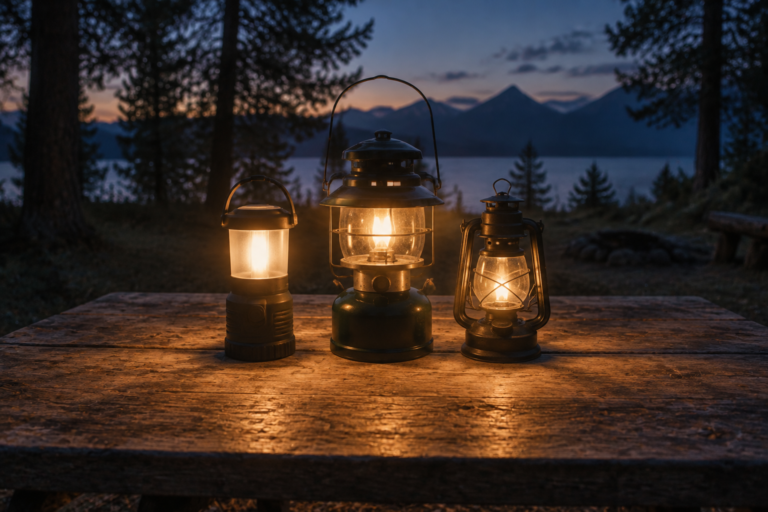
Camp lighting

Camping Lights and Lanterns

Camping lanterns, headlamps and string lights ranked on what they actually put out: measured lumens, runtime at a brightness you would really use, colour temperature and IPX water rating, across rechargeable, battery and solar power.

  • Lumens
  • Runtime
  • Power source
  • IPX rating
  • Colour temperature
How many lumens do I need for camping?

For a tent or a table, 100 to 300 lumens is plenty and far more pleasant than a floodlight. A main camp lantern lighting a whole group sits around 400 to 600 lumens. Above 1,000 lumens you are buying a work light, and runtime usually collapses to a few hours.

  • 65 products compared
  • 5 specs tracked
  • Data updated Sep 2026

What we measure in camping lights and lanterns

Lumen figures on packaging are usually a peak burst the light cannot hold. We pair output with the runtime you get at that output, because a bright lantern that lasts two hours is not a camp lantern.

  • LumensMeasured output, not the peak-burst number printed on the box.
  • RuntimeHours at a brightness you would actually use, not at the lowest setting.
  • Power sourceRechargeable, disposable, solar or a mix, and what each costs you off-grid.
  • IPX ratingHow much rain, splash or submersion the light survives.
  • Colour temperatureWarm or cold light, which changes how a camp actually feels at night.

Lantern Finder

Answer four quick questions and we match you against every product in the camp lighting database, then explain each pick and what it gets wrong.

Open the Lantern Finder

Camping Lights and Lanterns: common questions

How many lumens do I need for camping?

For a tent or a table, 100 to 300 lumens is plenty and far more pleasant than a floodlight. A main camp lantern lighting a whole group sits around 400 to 600 lumens. Above 1,000 lumens you are buying a work light, and runtime usually collapses to a few hours.

Rechargeable or battery camping lanterns?

Rechargeable lanterns cost less to run and often double as a power bank, but need a way to charge on longer trips. Disposable batteries keep working off-grid indefinitely and cope better with cold. Plenty of campers carry one of each, plus a headlamp per person.

Are solar camping lights any good?

Solar suits ambient and backup lighting rather than main lighting. A full day of direct sun typically yields a few hours at modest brightness, and output drops sharply in shade or cloud. Treat solar as a bonus charging method, not the only one you rely on.

What does IPX4 mean on a lantern?

IPX4 means the light survives splashes from any direction, which covers rain and heavy dew. IPX6 handles powerful jets, and IPX7 survives brief submersion. For camping, IPX4 is the practical minimum and IPX6 is worth paying for if lights stay out overnight.